

Octopuses are fascinating creatures, capable of navigating mazes, using tools, and even escaping aquariums. It’s a wonder they haven’t featured as video game protagonists more, given their potential for stealth, exploration, and puzzle solving. So, whilst octopuses have been player-characters before: Octogeddon weaponised mutant tentacles and Octodad masqueraded as a human, neither simulated octopus-themed mechanics earnestly like Darwin’s Paradox!
This cinematic, side-scrolling adventure from indie team ZDT Studio, then, brings a strong, relatively unique premise, casting you as a resourceful cephalopod who leans on its natural abilities and intelligence to navigate tricky platforms and solve environmental puzzles. With clear inspiration ranging from Playdead’s Inside to Moon Studios’ Ori, and through presentation infused with cartoonish movement, characterful animation, and a whimsical score, ZDT delivers a thoroughly charming, yet thoughtful experience.
"Where things begin to falter slightly is in the precision of platforming, particularly as the game introduces more demanding sequences."
And likewise, to the studio’s credit, much of their vision comes through too. The game rarely stumbles outright, but the ingenuity promised isn’t fully realised either. See, Darwin’s Paradox! is built on a brilliant idea, but it rarely stretches its inspiration as far as it could. This is a platformer that’s enjoyable in the moment, but only occasionally as inventive as its premise suggests.
I go back to this review’s outset: octopuses are uniquely suited to the kinds of systems video games thrive on, and Darwin’s abilities reflect that in ways that are immediately intuitive. Camouflage lends itself to subterfuge, firing ink allows opportunities to disrupt threats and divert attention, and his tentacles’ suction-based movement allows for traversal across walls and ceilings.
Even smaller touches, like impressive compression seeing Darwin squeeze through tight spaces, reinforce the idea that this is a character defined by adaptability. There’s a pleasing logic to how Darwin interacts with the world, as if each mechanic has been plucked from the real-world and reimagined through a playful lens. Because of this, there are plenty of moments where it feels like Darwin’s Paradox! is tapping into something genuinely fresh, but its novelty doesn’t always carry through to the broader experience.
For all the creativity in its mechanical foundations, the game falls back on standard platforming tropes too often. Pulling levers and pushing boxes make up the majority of the game’s obstacles, bringing the overall experience down to something more conventional.
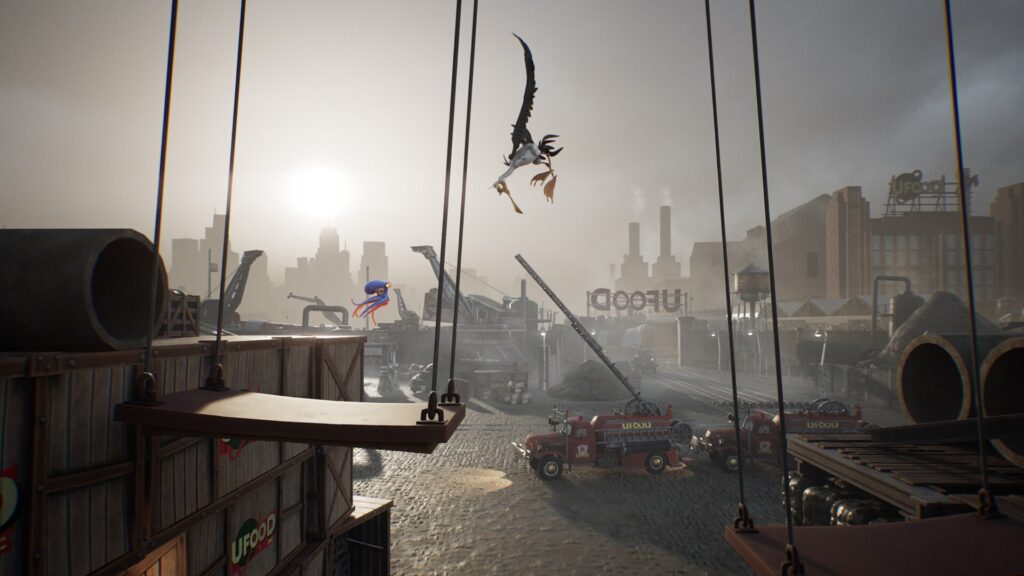
Yet, moment-to-moment, the game feels good in the hands. Movement is smooth and responsive, as Darwin shuffles, clings, and squeezes his way through environments with a fluidity that suits his character. Transitions between swimming, climbing, and platforming are handled seamlessly, often reinforced by expressive, almost-caricaturistic animation which gives even simple movements a memorable personality. Combined with lively environments – currents rippling through underwater sections, background machinery grinding in industrial areas, even fire engines responding chaotically to a factory blaze – it creates a strong identity which runs throughout.
Where things begin to falter slightly is in the precision of platforming, particularly as the game introduces more demanding sequences. Early on, the forgiving nature of movement works in the game’s favour, but later challenges expose a lack of clarity in how certain obstacles are meant to be overcome. Navigating giant rotating cogwheels or fast-moving conveyor belts feel less like tests of Darwin’s ingenuity and more like exercises in trial and error. I’m not talking Limbo-style learning-by-death, but it’s not far off.
And, because it’s not always possible to see far enough ahead to properly anticipate what’s coming, poor Darwin was squished, electrocuted, and burnt to a crisp often enough that it began to feel unfair. At best, these trickier “trial by death” sections break momentum, but worse: the charm and whimsy which the game’s mechanical systems are working hard to establish is replaced by unjust punishment and frustration.
"Each environmental puzzle is immediately understandable, and because of that, rarely surprising."
What would make these situations worse still are difficult puzzles. Yet, for a game that places so much emphasis on ingenuity, Darwin’s Paradox! delivers straightforward puzzle design. Now, I don’t believe this is inherently a problem; if it helps ease the pain of repeatedly failing through game design, then puzzles that are on the easy side are welcome. But, likewise, there’s value in keeping solutions readable and accessible too. However, this does sit slightly at odds with the expectations set by the game’s premise and its marketing alike. There’s no scope for experimentation here as most environmental obstacles funnel you toward a single solution.
In practice, this means puzzles feel functional rather than inspiring. As already alluded to, you’ll be moving objects into place and pulling levers frequently, alongside more contextual moments like sabotaging factory apparatus to manipulate the height of an object that you’ll inevitably use to scale an unreachable height.
Each environmental puzzle is immediately understandable, and because of that, rarely surprising. Again, games of this type don’t necessarily need complex solutions. Heck, even Inside, amongst Darwin’s primary influences, thrived on a minimalist approach. But, alas, in Darwin’s Paradox! there are flashes of more engaging action, particularly when octopus-specific abilities like camouflage or ink come into play, but these ideas aren’t explored as deeply or appear as frequently as they should. There’s a lingering sense that the puzzles here could have been designed to accommodate multiple solutions, or at least make fuller use of Darwin’s aquatic skills and compound intelligence. The lack of ingenuity stands out here more than it does in Inside, for instance.
"However, if there’s one area where Darwin’s Paradox! consistently shines, it’s in its presentation."
What Darwin’s Paradox! does have, however, is a decent amount of variety in its environments, shifting from aquatic shallows, to tight, sewer-like tunnels, plus a raft of industrial spaces like steaming production lines, fluorescent offices, and elaborate packing facilities, and more, all amplified with Looney Tunes flair. Certain chapters are punctuated by lively setpieces too, and these moments – explosive factory escapes, crumbling tower evasions, tenuous highwire platforming – not only inject a welcome sense of urgency but embellish the game’s comedic undertones, supported further by a rather pesky seagull adversary.
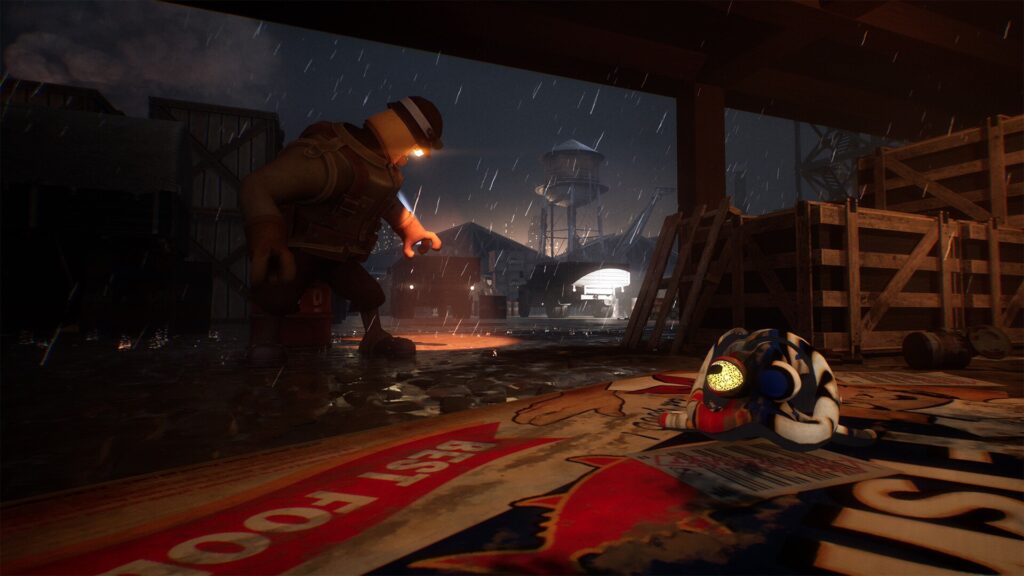
That said, overall flow can occasionally feel uneven. In one particular area – the office-like interiors where I leaned on Darwin’s camo ability to blend into cardboard, ceiling tiles, and sofa cushions – visual whimsy dominated over spatial clarity. Whilst tonally this fits, I felt my way through moments of disorientation, where the way forward wasn’t immediately obvious. Now, I know I’ve prattled on about puzzles being too obvious, and thus not surprising, but in these multi-level layouts of impossible architecture I had to use the hint system to help nudge my progress along. This could be my own skill issue, of course, but my gut feeling is that the level design didn’t communicate its intent as clearly as it should.
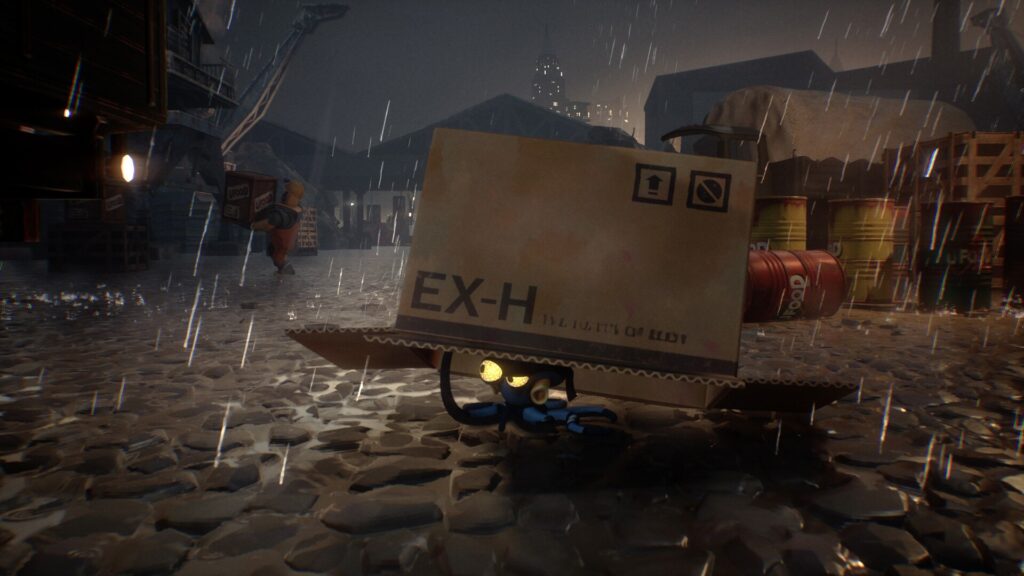
However, if there’s one area where Darwin’s Paradox! consistently shines, it’s in its presentation. Darwin himself is full of personality, brought to life through expressive animation. His slower, cautious movements – almost eight-legged tiptoeing – are a particularly humorous highlight, with the intrepid mollusc’s actions exemplifying the game’s offbeat world. This cartoonish tone carries through to the narrative, which gradually introduces a surreal, conspiratorial edge befitting Konami’s famous tactical espionage action series, one that is directly referenced here by exclamation points and cardboard boxes.
"Darwin’s Paradox! is a game built on genuinely inspired ideas, and when it’s at its best this creativity is reflected in expressive movement, memorable characterisation, and varied environments."
From a technical standpoint, performance is generally stable, though the distinction between visual modes is clear-cut. ZDT themselves advise playing with performance settings enabled, so that’s what I did. It proved to be much smoother than the alternative quality mode which sees a noticeable drop in framerate for a minimal fidelity boost. For a game with such fluid movement and emphasis on exaggerated animation, performance mode is definitely the preferable setting.
Audio design is solid throughout, with plenty of environmental sounds and tactile effects to sell the space Darwin is creeping through. Even less noticeable sounds like the soft suction of Darwin’s tentacles adds to the overall immersion. The orchestral soundtrack supports the game’s tone well, even if motifs and melodies rarely stand out as defining elements.
In conclusion, Darwin’s Paradox! is a game built on genuinely inspired ideas, and when it’s at its best this creativity is reflected in expressive movement, memorable characterisation, and varied environments. The game’s playfulness makes it an experience that’s easy to enjoy, even if its sometimes shallow systems keep this enjoyment at surface level. So, while it may not evolve into something truly exceptional, Darwin’s Paradox! remains a charming and worthwhile adventure, even if its greater potential is never fully reached.
This game was reviewed on the PlayStation 5.
Darwin’s Paradox! Review – A Mollusc Out of Water
Source: Buzz Trends Updates
0 comments:
Post a Comment